Machine learning paper recognized as a top download
OSU HEDP professor Chris Orban and his students have been working to enhance ultra-intense laser interactions with machine learning / artificial intelligence tools since 2021, thanks to funding from the National Science Foundation and the Department of Energy. There have been a couple of publications that are fruits of that effort, the first being Applying Machine‐Learning Methods to Laser Acceleration of Protons: Lessons Learned From Synthetic Data led by OSU graduate student Ronak Desai and OSU undergraduates Tom Zhang and Jack Felice which was published in 2024. In that paper, which is theoretical in nature, they create a model for the stream of data that a near future ultra-intense laser system might produce, and they use that data to train various "machine learning" models which is a branch of artificial intelligence. This test bed allows the authors to determine which machine learning models are poorly suited to learn from intense laser experiments without actually performing any experiments, or if the machine learning models require too much computational resources to be useful during a real experiment.
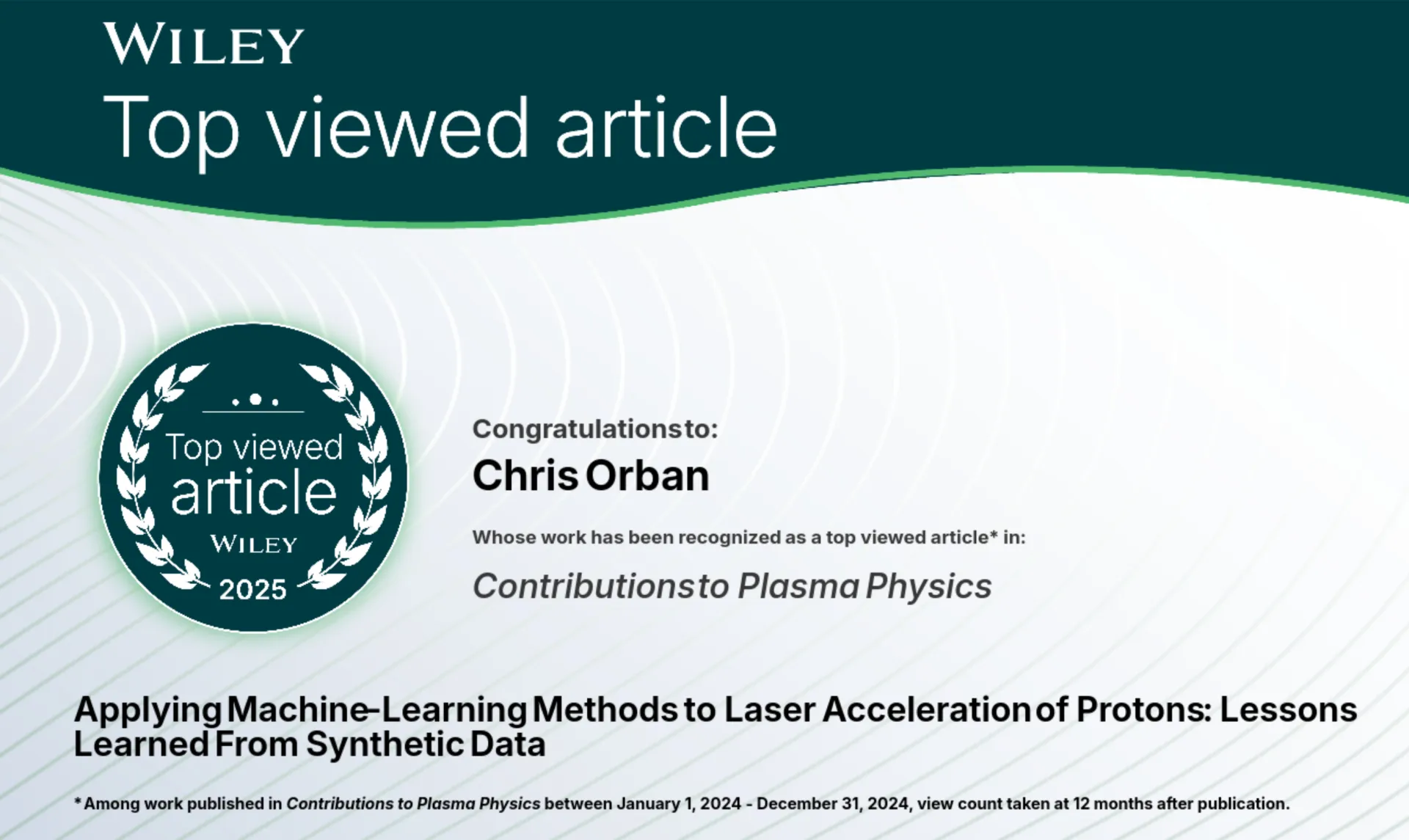
This week the journal Contributions to Plasma Physics recognized their paper as one of the 10% most viewed papers that were published in 2024.
Recently the theoretical framework described in the paper was used by another research group to test out a new machine learning model, as described in a publication in IEEE. The non-linear relationship between the attributes of the laser, the dimensions of the target, and the resulting spectrum of accelerated protons could become a standard test problem for new machine learning models in the sciences.
Other recent papers from Orban's students include Applying Machine Learning Methods to Laser Acceleration of Protons: Synthetic Data for Exploring the High Repetition Rate Regime led by OSU undergrad Jack Felice, who is currently a graduate student at the University of Maryland, and Towards Intelligent Control of MeV Electrons and Protons from kHz Repetition Rate Ultra-Intense Laser Interactions led by Nathaniel Tamminga who recently completed his Ph.D. at OSU. The paper he led is published in a special issue of the journal Applied Physics Letters: Machine Learning on Machine Learning for Self-Driving Laboratories.
Congratulations to everyone from the OSU HEDP group that contributed to these publications!
